

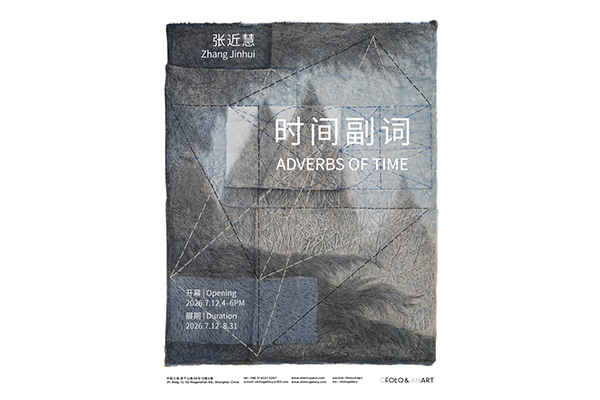
Adverbs of time are used to describe time—past, present, and future. In contrast to notional words in Chinese grammar, adverbs of time belong to the category of function words; they cannot stand alone. As function words that serve only a grammatical purpose, they act as prefixes to notional words, presenting time with certainty. In a sense, art is much the same—an adverb of time embedded in realities.
Line
My work begins with the line and ends with the line. The line records the process of time and leaves behind its traces.Line is the most basic element of form. From an initial intuitive and instinctive choice to a later conscious process of thinking, extending, and reconstructing, it has undergone a long journey. Traditional approaches have served as inspiration, and over the course of development, I have gradually formed my own tone, rhetoric, and visual logic.Line brings me calm, order, vitality, and a sense of security—it is a transformation or dissolution of reality.I closely bind geometric, mathematical lines with natural forms depicted through line—using measurement, perforation, and stitching—on fabric grounds that may be regular or irregular, flat or wrinkled, and of varying thickness and physical weight. Between these elements arise indeterminate yet clear or ambiguous relationships, and time is suspended in this space-time.
Space
Time and space are the intrinsically overlapping threads within the work.“The past and the present are called Zhou (time); the four directions and the above and below are called Yu (space)” —from the Huainanzi·Tianwen Xun. Space as Yu and time as Zhou constitute the traditional Chinese cosmological view, which emphasizes locating time through spatial positioning.Space provokes imagination as an opportunity—starting from a single line, it gives rise to multiple overlapping and juxtaposed spaces. This process is challenging: it could go this way or that, and there are moments of indecision. I am deeply interested in the relationships and intervals between spaces, as well as their ambiguous distance from reality. Multiple spaces—some direct, some concealed; some simple, some obscure—are like a labyrinth of the self.
Order
Through the picture plane, I reconstruct order to resist or escape the chaotic and complex realities.The inherent order within natural things in the cosmos—plants, rocks, clouds—and the rational, rigorous, and cool mathematical order within geometric structures appear quite different in form, yet they share the same root though diverging at the branches.By integrating mathematical space with soft lines and materials—where coldness and warmth, certainty and uncertainty, mathematical order and natural order coexist and interweave—I create a formal language that feels both familiar and strange.The entire mathematical space embodies order and rules. Within a limited square-inch realm, I establish order to alleviate the unease and strengthlessness brought about by rapidly changing society. The new forms in my creation connect with past modes of labor and emotion, becoming an extension of traditional methods—much like an adverb of time, encompassing past, present, and future.


