

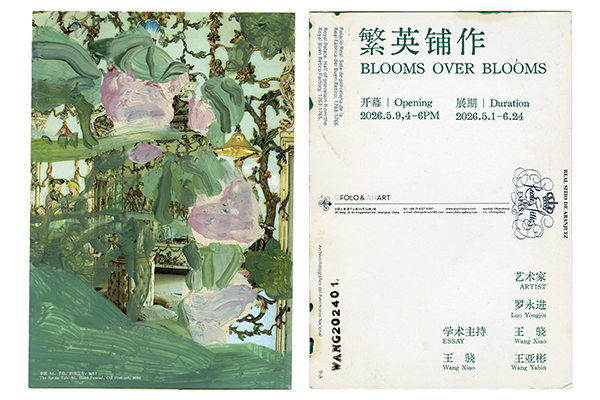
Wang Yabin
The Spring Tide series takes vintage postcards as its creative foundation, employing the language of oil painting for visual reconstruction. It places the gestural quality of Eastern freehand brushwork in dialogue with the original traces of the images, constructing a visual system centered on time, memory, and painterliness.
Vintage postcards inherently bear distinct textures of time: aged paper, worn edges, faded colors, and postmarks together form their historical materiality. In my creation, these original traces are preserved rather than deliberately concealed, using the historical nature of the found images as the objective premise for the intervention of painterly language.
Rooted in the emotional expression of Expressionism, the works integrate characteristics of freehand ink painting, building visual tension through techniques such as dry brushwork, splash color, and impasto application. Through color contrasts and layered textures, subjective brushstrokes interweave, overlay, and reconstruct the original imagery, achieving a collision and coexistence of old and new traces.
The integration of painterly language with pre-existing images is not a passive representation of the passage of time, but an active reshaping of memory and the past. Within my creative narrative, the surging spring tide endures eternally—time and memory transform into a ceaselessly rushing visual force, and the spring tide knows no end.
Wang Xiao
Between heaven and earth, all manifestations unfold in profusion: the hidden and the apparent, rise and decline—all are traces of natural creation, and all reflect the realm of the human heart. Presented here are sixteen photographic pieces, gathering the countenance of mountains, rivers, forests and springs, and the warmth of mortal life. Old stuffs and new traces interweave; in every gaze lies the order of nature and the authenticity of worldly experience. Hence this record.
Behold these images: misty waters stretch dimly, distant peaks hold their blue hue, dilapidated pavilions and idle boats drift far from the clamour of the world. Graceful bamboos and sparse flowers, stone paths tangled with green vines, stir up quiet charm. Discarded tools gather dust, yet withered woods sprout anew; old walls are draped in green, fallen petals still hold fragrance. Thus we see prosperity and decline follow in turn, fullness and emptiness abide by their course. We also find quiet moments of ordinary life: sitting at leisure, conversing with friends, enjoying brief peace in floating life, tasting the purest joys of the human world. The natural scenes conceal the mechanism of heaven and earth, and express the refinement of the spirit.
Scholars of the Tang and Song dynasties valued substance in writing, expressing genuine sentiment. Su Dongpo, though repeatedly beset by hardship, found peace in common sights, unmoved by external gain or loss. These photographs, whole or fragmentary, silent or noisy, withering or flourishing, embody the cyclical law of the universe, just as they reflect the constant rise and fall of human life.
No scene is superior or inferior; realm arises from the heart. Ruined walls hold the sediment of time; blooming flowers reveal exuberant vitality. Repose and motion harmonize; void and substance engender one another. To behold them is to cast off worldly disturbance, forget gain and loss, and comprehend the wordless beauty of heaven and earth.
Photography arrests the instant; a single frame contains the cosmos; a small view harbors profound feeling, much like the prose of Tang and Song: plain yet rich. Viewing these images, we sense the grace of nature, admire the openness of life, recognize the inevitability of growth and decay, and remain unshaken by honour or disgrace. Amid heaven and earth, we find tranquility within. Thus this record is made.
Luo Yongjin
Old photographs rest quietly on the desk. Between their yellowed pages are frozen scenes: mottled cornices of buildings, sunlight flooding through windows, and the ordinary warmth of life. Once, there was wind in the courtyards and voices in the lanes; every brick and tile carried the warmth of human existence. Gazing at them now, some of those familiar daily scenes have vanished into time, while others linger only as blurred outlines, gently swaying in memory.
The rise and fall of architecture is inherently a microcosm of the times. Old things fade away quietly, while new scenes emerge rapidly. In this cycle of renewal, the land bears the haste and transformation of the years. Only the hand-painted red and green flowers on the photo frames, like a touch of tenderness left by time, spread warmth against the bleak black-and-white background, weaving a bond between past and present. What we cherish is never cold architecture, but the irretrievable everydayness and the fleeting years deeply rooted in our hearts.
This quiet, lingering passage of time flows just like the scenes created by Tarkovsky’s lens. In Nostalghia, slow, poetic light sweeps over dilapidated houses and hazy old images, retrieving humanity’s spiritual homeland in silence. All of us are swept along by time, growing increasingly distant from the past. Even traveling to the ends of the earth, we can hardly regain the peace deep within our native land. Only these old images can harbor the bygone days with nowhere else to rest.
Great music is rarely heard; great images are formless. The most profound memories reside not in noise, but in stillness. The most genuine existence lies not in ostentation, but in accumulation. Time speaks no words, yet tells all vicissitudes; images make no sound, yet hold all affection. Those vanished scenes have not truly departed. They lie deep in time, gathering strength in silence, and becoming eternal in stillness.


